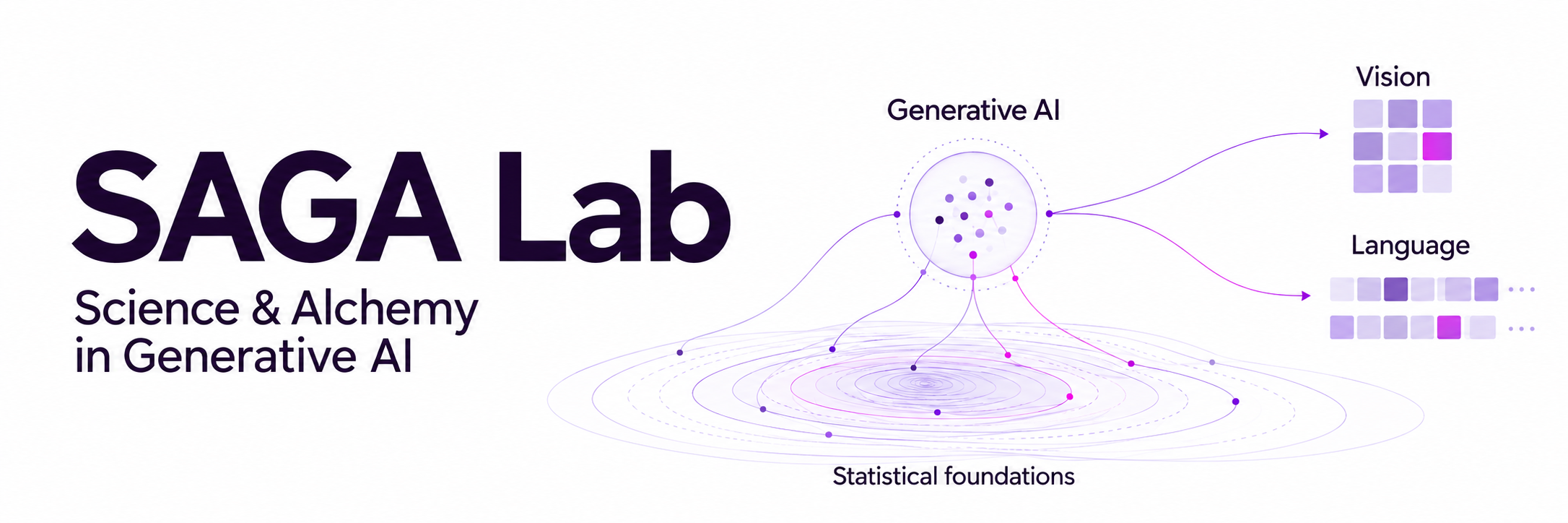
SAGA Lab is led by Tianyang Hu at the School of Data Science, The Chinese University of Hong Kong, Shenzhen.
We study the principles and algorithms of generative AI for language and vision. Our research examines how representations, architectures, and learning dynamics shape model capabilities and efficiency. By combining statistical theory, mechanistic analysis, and empirical exploration, we aim to develop models that learn more efficiently, generate with less computation, and offer better control.
Science & Alchemy reflects our approach: turning empirical observations into scientific understanding, and that understanding into better models.
Research directions
Vision
Efficient and controllable generation
We study efficient pretraining through the design of latent representations and autoregressive visual models. For efficient sampling, we develop accelerated diffusion samplers and distillation methods. Our work on control and preference alignment explores guidance, model inversion, and learning from rewards to improve generation quality and controllability.
Language
Toward next-generation LLMs
We focus on language model pretraining, using mechanistic understanding to guide architecture design and improve how models learn. Our work spans attention and information flow in autoregressive and diffusion language models. We also investigate memory mechanisms, including how models represent and use contextual information.
Application domains
Generative AIStatistical foundations
We study statistical learning theory, focusing on how model complexity, regularization, and learning objectives affect generalization. We also investigate the geometry and topology of representations, linking contrastive learning to neighborhood structure and developing tools to compare learned representations. These perspectives help explain model behavior and guide algorithm design.
Recent focus
Continuous Diffusion Language Models
Continuous diffusion language models (CDLMs) generate text by iteratively refining noisy continuous representations and decoding the resulting states into tokens. Multiple token positions can evolve together, opening new ways to organize computation and coordinate language generation.
This direction naturally brings together our experience in continuous diffusion and GPT-style autoregressive modeling. We explore how continuous refinement and autoregressive context can complement each other, drawing on our work in representation learning, model mechanisms, and efficient generation.
We lead the Polyadic Research Group and contribute to open-source development in continuous diffusion language modeling. Our vision is to develop more capable, efficient, and controllable language models. We study how representations, learning dynamics, and model design shape the refinement process, and use these insights to guide better training and sampling.
Join SAGA Lab
We are recruiting PhD and MPhil students and research assistants with strong foundations in statistics, mathematics, or computer science and hands-on AI research experience. We place particular emphasis on research fit with our current directions, looking beyond grades and publication count to the relevance and depth of your preparation.
If you are interested in pursuing research aligned with our current directions, please email Tianyang Hu with your CV and a brief description of your research interests and experience.
Members
Current Members
PhD Students
- Yan Wang, 2026 Fall - present.
- Bowen Zheng, 2025 Fall - present.
MPhil Students
- Yuxiang Zhao, 2026 Fall - present.
- Yuhuan Lyu (co-supervised with Prof. Pinjia He at School of AI), 2026 Fall - present.
- Yongzhao Chao (co-supervised with Prof. Jianhua Huang at School of AI), 2025 Fall - present.
Research Assistants
- Hao Jiang, master student from Harbin Institute of Technology, Shenzhen.
- Jingran Ge, undergrad student from Zhejiang University.
- Chenhe Yang, master student from CUHK-Shenzhen.
- Haozhe Zhu, master student from CUHK-Shenzhen.
- Yihao Shen, undergrad student from CUHK-Shenzhen.
- Ruixi Chen, undergrad student from CUHK-Shenzhen.
- Yulei Sun, undergrad student from CUHK-Shenzhen.
- Jiayi Han, undergrad student from CUHK-Shenzhen.
- Yujian Chen, undergrad student from Peking University.
- Mingzhi Zhang, undergrad student from Peking University.
- Zhiyuan Liu, undergrad student from Peking University.
- Xinlang Cai, undergrad student from Peking University.
Former Members
Research Assistants
- Siquan Li, worked on understanding and improving LLMs (ICLR 2026, ICLR 2026, ICML 2026), while pursuing a master’s degree at the National University of Singapore. Now in the B2C LLM group at Tonghuashun (同花顺).
Research Interns at Noah’s Ark Lab
Research interns advised by Tianyang Hu during his time at Noah’s Ark Lab. The affiliations below refer to the period of the internship.
-
Yihong Luo, worked on diffusion distillation (ICLR 2025, ICCV 2025) and controllable generation (ICCV 2025, NeurIPS 2025, NeurIPS 2025), while pursuing a PhD at HKUST.
-
Shuchen Xue, worked on diffusion sampling acceleration (ICML 2024, CVPR 2024) and discrete diffusion models (ICML 2026), while pursuing a PhD at the University of Chinese Academy of Sciences.
-
Jakub Wornbard, worked on the duality between prompts and model weights in Transformers, while pursuing a MS at the University of Cambridge.
-
Xuantong Liu, worked on conditional generation via model inversion (ICML 2024), while pursuing a PhD at HKUST.
-
Jiajun Ma, worked on diffusion sampling acceleration (ICLR 2024) and classifier guidance (ICML 2024), while pursuing a PhD at HKUST-Guangzhou.
-
Weijian Luo, worked on diffusion distillation (NeurIPS 2023), while pursuing a PhD at Peking University.
-
Yi Liu, worked on optimal latent space for generative modeling, while pursuing a BS at CUHK-Shenzhen.
-
Paweł Piwek, worked on boundary complexity for ReLU classifiers (UAI 2023), while pursuing a PhD at the University of Oxford.
-
Yimeng Chen, worked on model ensemble for domain generalization (ICML 2023), while pursuing a PhD at the University of Chinese Academy of Sciences.